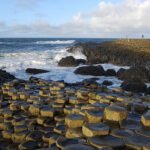




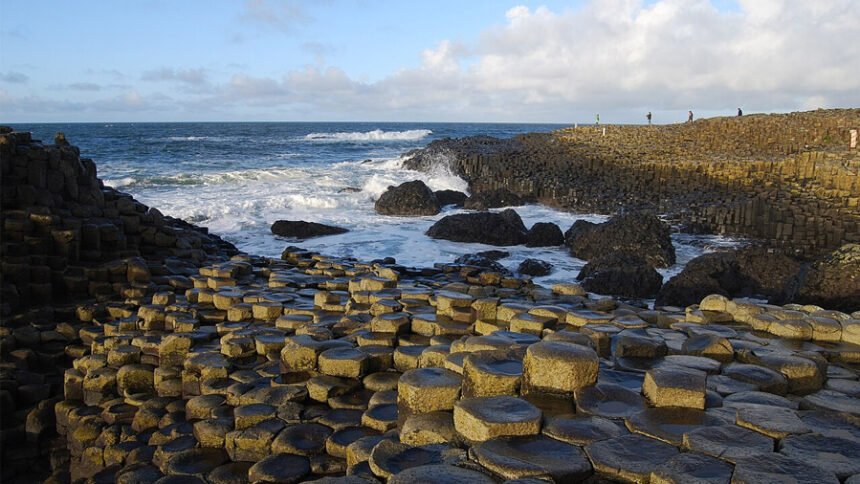
Crashing North Atlantic waves thunder against dark geometric stone towers rising sharply from the misty Irish shoreline. Wind sweeps violently across County Antrim, carrying salty spray over thousands of tightly fitted basalt columns that look like a pathway built by mythical monsters. Walking along this eerie coastal formation fills travelers with profound wonder as the boundary between geological fact and epic mythology vanishes entirely.
Sixty million years ago, cataclysmic volcanic activity reshaped this entire northern landscape under immense geothermal pressure. Boiling subterranean magma burst through ancient chalk beds, cooling rapidly upon contact with cold ocean water to freeze into thousands of precise geometric pillars. However, ancient Celtic stories offer an entirely different narrative, claiming legendary hunters constructed this massive stone highway to battle Scottish rivals.
Today, this protected UNESCO World Heritage Site attracts global explorers seeking unforgettable road trip adventures along spectacular coastal routes. Rare sea birds glide above high seaside cliffs while delicate botanical species flourish among the ancient basalt cracks. The incredible mystery surrounding these geometric coastal stones continues to captivate millions of curious minds worldwide.
Along Northern Ireland’s rugged northeast coast today, environmental conservationists and international travelers explore the Giant’s Causeway, a renowned geological site featuring over forty thousand volcanic basalt columns near Bushmills in County Antrim. Geologists explain that severe volcanic eruptions occurring between fifty and sixty million years ago created this vast lava plateau when molten rock cooled rapidly against ocean waters. Meanwhile, cultural historians note that rich Irish mythology links these unique hexagonal pillars to the legendary warrior Fionn Mac Cumhaill and his mythical battle against a Scottish giant named Benandonner. Recognized as a UNESCO World Heritage Site, this breathtaking natural sanctuary currently draws thousands of tourists annually who travel along the scenic Causeway Coast to witness rare wildlife, dramatic cliffs, and ancient coastal stone formations.
Related News
The Epic Volcanic Origins of Ireland’s Geometric Coastline
Between fifty and sixty million years ago, violent subterranean forces tore open the earth across Northern Ireland. Immense volumes of molten basaltic lava poured through deep fissures, flooding surrounding chalk landscapes with incandescent rock. As volcanic activity gradually subsided, massive lava pools settled across the coastal territory, creating an expansive molten plateau.
Subsequently, swift thermal shifts triggered an extraordinary natural cooling process across the cooling basalt mass. Exposure to cold sea air and ocean water caused the molten surface to contract rapidly and crack with surprising geometric precision. Consequently, these contracting stress patterns formed thousands of vertical stone columns featuring regular four, five, six, seven, and eight-sided geometric shapes.
Most columns display perfect hexagonal structures, fitting together like a gigantic, intricate stone puzzle along the water. While some basalt towers reach impressive heights of twelve meters, surrounding cliff walls display dramatic column formations rising twenty-eight meters high. Furthermore, vast networks of identical basalt pillars extend far beneath the churning Atlantic ocean surface, continuing across the sea floor toward Scotland.


Clash of Titans: The Timeless Legend of Fionn Mac Cumhaill
Long before modern scientists identified volcanic cooling processes, local inhabitants turned to vibrant Gaelic folklore for answers. Ancient Irish myth tells the heroic tale of Fionn Mac Cumhaill, a celebrated hunter and mythical giant warrior. According to legend, Fionn built a massive stone causeway across the sea to challenge his fierce Scottish rival, Benandonner.
After traversing the ocean highway, Fionn realized his opponent possessed terrifying strength and colossal physical size. Fionn retreated quickly, while his clever wife disguised him as a infant inside a oversized cradle to deceive the enemy. When Benandonner observed the huge baby, he foolishly assumed the child’s father must be an impossibly massive giant.
Terrified by Fionn’s prospective strength, Benandonner fled frantically back to Scotland, tearing up the stone road behind him. Mythological tales suggest that only the broken ends of the causeway survived at both coastal edges of the sea. Today, this captivating folk narrative remains deeply intertwined with the cultural identity and tourism appeal of the region.



Rediscovery, Modern Exploration, and Coastal Conservation Efforts
Although local residents knew the basalt coastline for generations, official historical records document its outside discovery in 1692. The Bishop of Derry visited the site and reported the strange geometric stones to academic circles in 1693. However, international scientific consensus regarding the site’s true volcanic origin only solidified much later in 1771. Modern international recognition eventually led UNESCO to designate the site as a World Heritage location during the late twentieth century.
Modern travelers usually access the natural wonder by navigating the famous Causeway Coast route, located three kilometers from Bushmills. Driving along these winding coastal roads reveals dramatic ocean vistas, hidden sea caves, and towering coastal cliffs at every turn. Visitor management authorities ensure that heavy tourist traffic does not harm delicate mosses, rare plants, or protected nesting seabirds.
Environmental protection remains vital for preserving this pristine natural sanctuary for future generations of global travelers. Exploring this remarkable landscape allows visitors to experience where deep earth history meets ancient human imagination.