




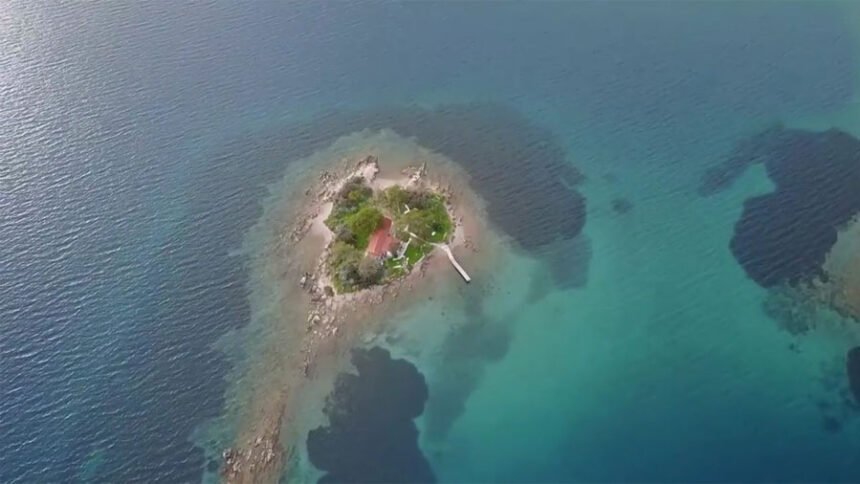
Picture a speck of rock so small most maps skip it entirely. Locals call it Daskalio, a bare islet floating off uninhabited Keros in Greece. Archaeologists now believe it once hummed with one of the most advanced communities in the ancient Aegean. Seen from above, the rock forms an almost perfect pyramid rising from turquoise water, as if someone dropped a miniature Giza into the Cyclades. Nature sketched the outline first. Then human hands got greedy and sharpened it. Builders carved terraces, raised staircases, and wrapped the whole hill in gleaming white marble. Teams from the University of Cambridge have dug here for years, pulling up proof that predates the Minoans entirely. Metal workshops, hidden drainage channels and thousands of smashed offerings all whisper the same thing: somebody here knew far more than history ever gave them credit for. Reaching the islet still means chartering a private boat, since no hotel, shop or ferry route dares come close. That isolation is exactly what kept the secret buried for four and a half thousand years, waiting patiently for someone to notice.
Why Would Anyone Carve a Mountain by Hand?
Daskalio sits barely fifty meters from Keros, tucked inside the Small Cyclades near Naxos. Its pyramid shape existed long before a single chisel ever touched the stone. Ancient builders, however, apparently couldn’t resist a good makeover. They hauled over a thousand tons of gleaming marble across ten kilometers of open sea, no small feat by boat. With it, they raised six massive terraces, each braced by heavy retaining walls. Two-story buildings climbed those platforms, complete with staircases and polished facades fit for royalty. Sunlight would have bounced off all that marble, turning the tiny islet into a shining beacon visible for miles around. Archaeologists Colin Renfrew and Michael Boyd, both from Cambridge’s McDonald Institute, call it the earliest large-scale monument ever found anywhere in Greece. Even wilder, their evidence suggests builders finished the entire complex in roughly forty years, all from one unified blueprint.
The Secret Hiding Beneath the Marble
Beneath those gleaming terraces sat something nobody saw coming. A tangled network of drainage channels ran through the lower levels, among the oldest water systems ever documented anywhere in Europe. Whoever built this understood hydraulics centuries before anyone bothered writing a word down. Then came the real plot twist: metal. Later digs uncovered two separate workshops packed with copper residue, ceramic blowtorch tips and a lead axe head. Researchers even found a mold once used for casting bronze knives, sitting cozily beside an intact clay furnace. Co-director Michael Boyd believes metalworking skill was deliberately concentrated on this one tiny islet, almost like an ancient factory floor. Every scrap of copper had to arrive by boat, since Keros itself holds none at all. That kind of specialization hints at trade routes stretching far beyond this speck of rock, centuries before classical Greece even got started.
A Lost Civilization That Beat the Minoans to Glory
Here’s the detail that stops archaeologists cold: timing. Artifacts pulled from Daskalio predate Minoan civilization, long crowned Europe’s very first great culture. That makes this tiny Cycladic outpost one of the oldest sophisticated societies ever unearthed on the continent, and nobody saw it coming. Renfrew has gone even further, calling nearby Keros the world’s oldest known island sanctuary. Thousands of deliberately shattered marble figurines litter the site, hinting at rituals long lost to time. Pilgrims likely sailed here from across the Aegean Sea, offerings clutched tight, drawn to something they considered sacred. Yet nobody can say who these people actually were. No written word survives to explain any of it. Every fresh artifact only deepens the riddle instead of solving it, which is exactly what makes this place so irresistible.
Would You Dare Sail to the Edge of Nowhere?
Forget gift shops and guided tours; this island doesn’t do souvenirs. Daskalio offers nothing but bare rock, salty wind and total silence. Reaching it means finding Keros first, usually aboard a private boat departing from nearby Pano Koufonissi. Once ashore, visitors find nothing but stone and an eerie stillness some locals swear feels almost magnetic. Ruins and artifacts dating between 2000 and 3000 BC still rest on the seabed nearby, half-swallowed by the tide and waiting to be rediscovered. For anyone craving genuine mystery, untouched by crowds or selfie sticks, this is about as rare as travel gets. Digs continue every summer, and each new season threatens to rewrite the whole story again. Until then, Daskalio keeps guarding its riddle quietly, sunbathing beneath the Greek sky.