




Shining bright under dazzling stage lights or solving complex equations within quiet academic halls, elite performers captivate human curiosity worldwide. For decades, researchers debate whether extraordinary skill stems from innate biological gifts or countless hours of disciplined practice. Modern talent shows romanticize a mysterious spark of natural brilliance, convincing millions that destiny alone dictates supreme achievement. However, groundbreaking psychological investigations dismantle this simplistic myth, revealing a far more intricate neurological reality.
Achieving world-class status demands much more than brute repetition or random genetic luck. Recent scientific breakthroughs prove that physical brain structures, emotional resilience, specialized cognitive skills, and family environments shape exceptional capabilities simultaneously. Furthermore, overemphasizing practice overlooks critical factors like neural plasticity, childhood opportunities, and psychological adaptability. Understanding how these diverse elements converge unlocks deep insights into human potential and personal growth. Step inside the fascinating science of human performance to discover what really separates good performers from legendary pioneers.
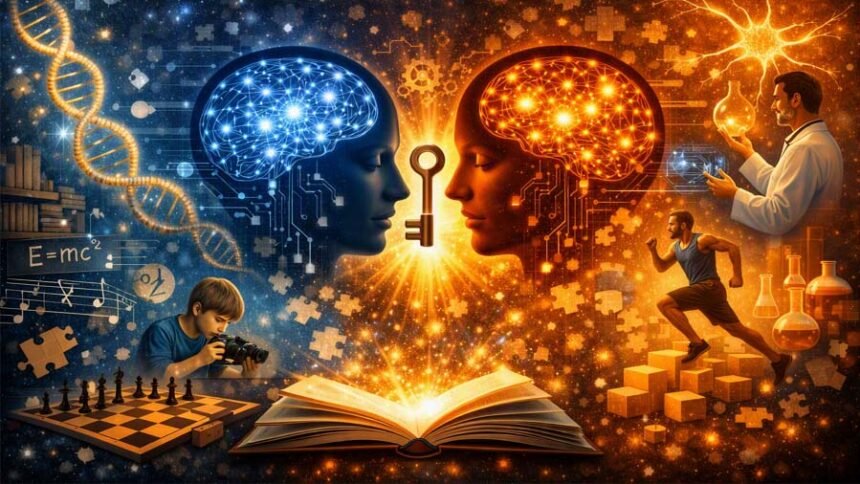
During extensive psychological investigations across global research centers, scientific teams analyzed thousands of elite performers to decode the true origins of human talent. Experts from Princeton University, Michigan State University, and Rice University evaluated over eighty independent studies involving eleven thousand participants. Their landmark meta-analysis revealed that deliberate practice contributes surprisingly little toward ultimate success, accounting for only eighteen percent of sports performance and twenty-six percent of cognitive skills like chess. Consequently, cognitive psychologists now urge society to abandon single-cause theories of human mastery.
Furthermore, renowned cognitive researchers emphasize that genuine excellence emerges from an intricate combination of personality traits, optimism, physical predispositions, and early environmental opportunities. Studying historical figures and modern prodigies proves that structural brain anomalies sometimes interact with disciplined study to create phenomenal abilities. Consequently, scientists highlight how early exposure during childhood neural development plays a decisive role in shaping lifelong cognitive flexibility.


The Biological Foundations and Psychological Drivers of Mastery
Unique physical characteristics often grant performers substantial advantages in highly specialized competitive arenas. For instance, violin virtuoso Niccolò Paganini utilized hyper-mobile hand joints caused by Marfan syndrome to execute complex musical compositions effortlessly. Similarly, legendary physicist Albert Einstein possessed an unusually enlarged inferior parietal lobe, which significantly enhanced his spatial reasoning and abstract mathematical visualizations.
In addition, positive psychological attitudes actively fuel long-term skill acquisition across demanding professional environments. Cognitively gifted individuals demonstrate realistic optimism, assessing challenges accurately without underestimating or overestimating their personal abilities. Moreover, international health authorities like the World Health Organization emphasize that holistic mental well-being accelerates personal development and cognitive resilience throughout life.
Furthermore, exceptional performers usually cultivate broad interests rather than restricting their curiosity to a single narrow domain. Versatile minds easily draw connections between disparate fields, generating innovative solutions that hyper-specialized individuals often overlook. Consequently, maintaining broad intellectual curiosity protects professionals against creative burnout and rigid problem-solving approaches.

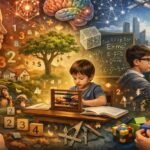

Additionally, cognitive flexibility allows experts to adapt quickly when facing unexpected challenges or changing market conditions. Rather than relying on rigid, repetitive formulas, adaptable minds constantly synthesize new information to refine their methodologies. Developing diverse cognitive toolkits enables top achievers to maintain competitive advantages throughout shifting career landscapes.
Moreover, intrinsic motivation serves as a crucial engine that sustains individuals through years of rigorous training. Driven by deep internal passion rather than external praise, resilient individuals embrace difficult challenges with genuine enthusiasm. Cultivating authentic joy within specialized pursuits transforms tedious practice into a fulfilling journey toward self-mastery.
Environmental Influence, Childhood Development, and Team Dynamics
Childhood development represents a crucial window for cultivating exceptional human abilities safely and effectively. Human brains exhibit extraordinary neural plasticity before age twelve, allowing young learners to form fast synaptic connections during skill acquisition. For example, Wolfgang Amadeus Mozart developed legendary musical mastery early because his father provided rigorous instruction within a supportive home environment.

However, pushing children too hard creates severe emotional risks, leading to perfectionism and psychological fragility. Discrepancies between advanced intellectual capabilities and developing emotional maturity frequently cause deep internal distress in young prodigies. Therefore, parents and educators must balance rigorous technical training with warm, compassionate emotional guidance.
Furthermore, assembling overly talented individuals within sports teams or corporate organizations sometimes degrades collective performance. Excessive individual brilliance often undermines team cohesion, as overly confident members resist alternative perspectives and collaborative strategies. Ultimately, sustained success requires blending individual skill with humility, emotional intelligence, and genuine cooperative spirit.
In addition, institutional environments and mentorship networks significantly shape how effectively emerging talent matures over time. Access to high-quality facilities, expert guidance, and supportive peer groups drastically reduces friction during the early stages of professional development. Surrounding ambitious individuals with inspiring role models fosters a culture of continuous learning and high standards.
Finally, socio-economic stability provides young individuals with the psychological safety required to take creative risks. Unburdened by immediate financial pressures, supported learners explore unconventional ideas and dedicate long hours to mastering intricate subjects. Building inclusive educational frameworks ensures that talented individuals from diverse backgrounds access equal opportunities to fulfill their highest potential.
Re-evaluating Exceptional Memory and Unique Cognitive Anomalies
Beyond traditional fields of art and science, rare neurological conditions shed fascinating light on the absolute limits of human memory. Extraordinary cases of hyperthymesia demonstrate that certain individuals retain vivid, flawless memories of almost every calendar day throughout their adult lives. Studying these unique individuals reveals how specialized brain architecture can dramatically alter how human beings process, store, and retrieve daily life experiences.
However, extreme neurological specialization sometimes accompanies complex trade-offs in social and emotional functioning. Some individuals possessing hyper-specific mathematical or recall abilities struggle with abstract reasoning, emotional regulation, or everyday interpersonal relationships. Scientists note that true talent differs fundamentally from isolated cognitive anomalies, requiring a well-integrated brain capable of applying knowledge dynamically across varied contexts.
Furthermore, exploring how memory systems interact with creative thinking helps researchers design better learning techniques for the general public. Modern educational frameworks increasingly adopt mnemonic strategies, spatial mapping, and spaced retrieval to help ordinary students absorb complex information more efficiently. Transforming specialized memory techniques into accessible educational tools empowers learners everywhere to expand their natural cognitive boundaries.
Ultimately, human excellence represents a rich, multifaceted synthesis of biological gifts, emotional maturity, environmental nurturing, and lifelong curiosity. Recognizing that genius relies on far more than luck or relentless practice allows individuals to approach personal development with balanced optimism. By cultivating healthy environments and honoring individual strengths, society fosters a new generation of creative, resilient, and truly exceptional leaders.