


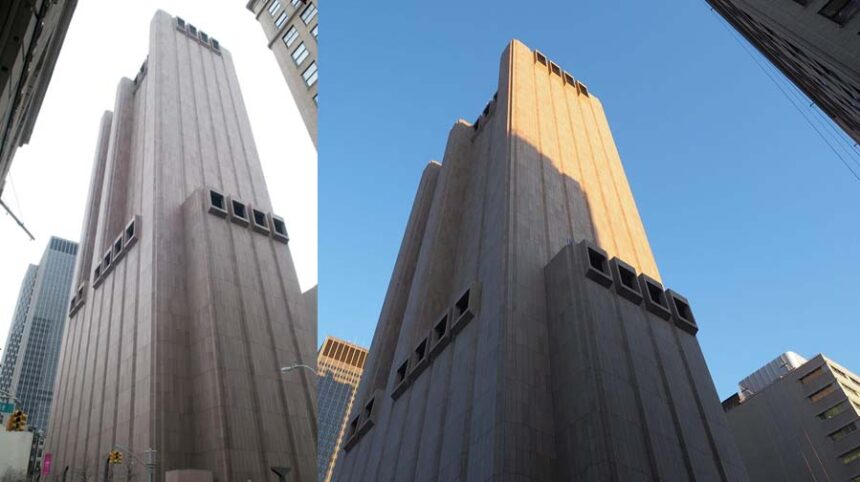
Architect John Carl Warnecke designed a massive, windowless skyscraper at 33 Thomas Street in Manhattan during 1974. The American telecommunications giant AT&T funded this ambitious engineering endeavor to safeguard vital telephone switching equipment. Located in lower New York City, the 167.5-meter concrete monolith was built to withstand nuclear blasts for two weeks.
In an era dominated by transparent glass towers, this brutalist landmark stands completely unique among 5,818 city skyscrapers. Furthermore, urban planners inspect the structure to understand how cold war fears shaped modern American urban design. Featuring thick walls clad in Swedish granite, the building operates as a completely self-sufficient fortress. Additionally, specialized ventilation systems on the tenth and twenty-ninth floors maintain internal air circulation without compromising outer security. Today, researchers identify this monolithic wall as a dramatic testament to high-security brutalist architecture.
Cold War Fears Shape Brutalist Architecture
Post-war architectural trends heavily influenced American building designs throughout the mid-twentieth century, favoring raw concrete surfaces and functional geometry. Architect John Carl Warnecke embraced these fundamental principles when creating the initial blueprints for AT&T’s critical technological center.
Rather than installing thousands of glass panels like neighboring corporate offices, construction crews poured reinforced concrete walls. Consequently, workers lined the entire exterior surface with heavy slabs of premium Swedish granite to guarantee maximum structural durability.
Furthermore, these dense material choices protected delicate routing computers from external atmospheric changes, sudden explosions, and direct radiation. Urban scholar William H. Whyte analyzed the structure, noting that its sheer facade formed the world’s largest blank wall.
In addition, the decision to eliminate windows entirely reflected a deliberate shift toward ultra-defensive urban infrastructure. During this tense geopolitical era, telecom networks represented the literal nervous system of national communication and defense.
Therefore, architects prioritized absolute physical security over traditional aesthetic brightness or open office concepts. As a result, 33 Thomas Street became an imposing symbol of raw industrial strength in lower Manhattan.
Engineering a Self-Sustaining Nuclear Shelter
Designers specifically built the AT&T Long Lines Building to survive catastrophic world events without relying on public utilities. Internal generators, vast fuel reserves, and independent water storage facilities allow full operation during severe national crises.
In fact, engineers guaranteed that hundreds of essential personnel could live inside the fortress safely for two weeks. Consequently, security experts frequently classify this indestructible concrete giant as America’s safest and most resilient commercial structure.
Specialized architectural features further enhance its defensive capabilities while maintaining essential interior functionality for high-tech machinery. For instance, six large rectangular protrusions along the outer walls house vital elevator shafts, fire escape stairwells, and air ducts.
Moreover, the entire internal structural framework was engineered to absorb immense kinetic shockwaves from nearby explosions. Heavy structural dampening mechanisms isolate critical machinery bays from violent ground vibrations caused by seismic or explosive events.
Consequently, the facility could maintain uninterrupted long-distance phone routing even if surrounding city infrastructure suffered total destruction. This level of extreme architectural redundancy remains virtually unmatched in modern commercial skyscraper design.
Technical Airflow Systems Replace Traditional Windows
Operating heavy telecommunications hardware generates immense thermal energy that requires constant, highly controlled internal cooling systems. Therefore, engineers devised specialized ventilation openings along the tenth and twenty-ninth stories rather than installing standard open windows.
These large mechanical cutouts draw in outside air while shielding sensitive equipment from extreme environmental weather conditions. Meanwhile, solid concrete exterior barriers block natural sunlight entirely, maintaining perfectly stable interior ambient temperatures year-round.
Additionally, this windowless design prevented industrial espionage and physical break-ins during sensitive international telecommunication operations. By eliminating standard structural vulnerabilities, the building preserved vital communication links across major metropolitan networks.
Furthermore, internal air filtration systems were designed to scrub incoming air of toxic fallout and airborne contaminants. This complex environmental control setup ensured that sensitive electronic switching gear remained dust-free and operational under extreme external conditions.
By utilizing advanced mechanical airflow shafts integrated directly into the outer granite protrusions, designers balanced climate control with total containment. As a result, the building’s technical interior operates seamlessly isolated from Manhattan’s unpredictable coastal weather.
Modern Legacy of New York’s Granite Giant
Today, the towering structure officially uses its street address, 33 Thomas Street, as its primary identity. Passersby frequently gaze up at the imposing blind facade, marveling at its stark contrast to surrounding modern glass skyscrapers.
Although technological advancements downsized physical hardware needs over recent decades, the building maintains its critical telecom infrastructure role. Furthermore, architectural historians recognize the tower as an iconic masterpiece of international brutalist design.
Ultimately, this monolithic landmark reminds city residents of an era when corporate architecture prioritized total survival above all else. Its impenetrable walls continue standing silently, guarding vital networks deep beneath the bustling streets of Manhattan.
In addition, urban legends and pop culture mysteries frequently orbit the enigmatic, windowless skyscraper in lower Manhattan. Photographers, tourists, and digital content creators regularly feature its dark, fortress-like silhouette in modern architectural documentaries. Despite changing stylistic preferences in city design, 33 Thomas Street remains an unyielding physical testament to Cold War engineering. Its massive Swedish granite facade guarantees that this unique architectural giant will endure for generations to come.