

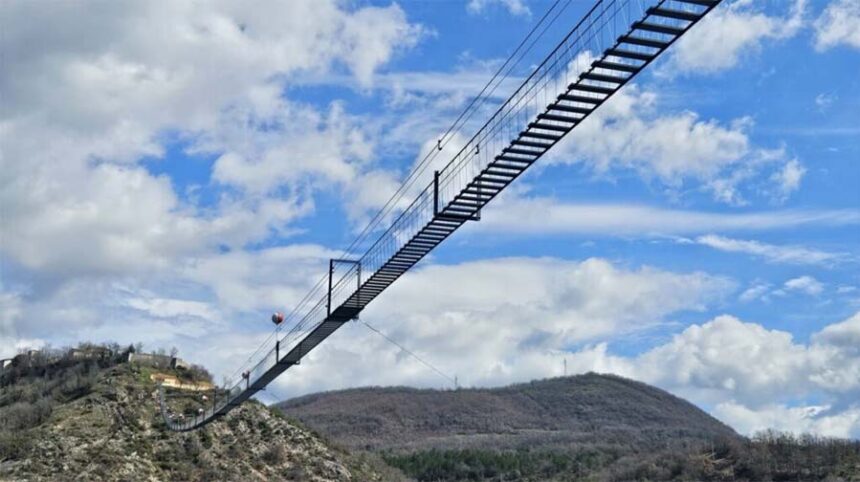
A purpose‑built tibetan‑style bridge in Castelsaraceno, province of Potenza, celebrates its fifth anniversary in 2026 after becoming one of the world’s longest single‑span suspended walkways. Constructed to span a canyon and connect two protected mountain areas, the installation was designed to resist severe weather and to offer panoramic views across ancient forests and rocky valleys. Local authorities and regional tourism bodies organized a multi‑day cultural and sporting festival to mark the milestone, showcasing highline performances and workshops. The bridge exists to attract visitors, stimulate the local economy, and promote outdoor education while maintaining strict safety and conservation standards.
A Bold Engineering Statement in Basilicata
The bridge’s structure relies on heavy‑duty steel cables anchored to natural rock outcrops between the Raparo and Castelveglia ridges. The walking surface is a robust metal grating engineered to remain stable under strong winds while allowing natural ventilation and drainage. Designers incorporated a gently inclined ramp and stepped approaches to ease access from the village level to the suspended span. The entire crossing typically takes between thirty and forty minutes, depending on pace and stops for photography. Staffed safety checks and certified harnesses are mandatory, ensuring the attraction remains accessible to a broad public without compromising structural integrity.
The Visitor Experience: Safety, Rhythm, and Rules
Before stepping onto the walkway, every guest undergoes a safety briefing and is fitted with a certified harness supplied by trained personnel. The staff provide clear instructions and accompany groups to manage flow and reduce congestion. Online booking is strongly recommended, particularly during peak summer months, to avoid long queues at the entrance. Visitors are advised to wear closed athletic shoes for secure footing on the metal grid. The bridge’s slight, natural oscillations heighten the sensation of suspension, and technical staff remain on hand to reassure first‑time crossers. These operational measures balance thrill with responsibility.
Five Years On: Festival, Performance, and Film
To mark the fifth anniversary, local authorities and the regional tourism agency staged an event called “Tra Cielo e Terra” from July 31 to August 2. The program featured the French collective Les Passagers du Vide, who presented highline demonstrations and led slackline workshops. Organizers also screened award‑winning documentaries about extreme expeditions, and planned a short film to represent the celebrations at the Visioni Verticali festival in Potenza. The anniversary aimed to fuse athletic spectacle with cultural storytelling, positioning the bridge as both a sporting arena and a stage for creative interpretation of the landscape.
Practical Guide: Getting There and Planning Your Visit
Castelsaraceno is reachable via the regional road network, with direct connections from Potenza and coastal routes toward Salerno. Visitors arriving by car can park near the historic centre, then follow marked pedestrian routes to the check‑in point close to Piazza Piano della Corte. Ticketing favors online purchases, and discounted fares are available for families, children, and organized groups. Weather conditions can affect access, so planning around forecasts is prudent. The village itself, with its heart‑shaped layout, invites exploration before or after the crossing, offering local food and hospitality that complement the outdoor experience.
Cultural and Economic Ripples in the Appennines
The bridge has become a catalyst for local development, drawing outdoor enthusiasts and photographers while supporting accommodation and dining businesses. Rather than imposing on the landscape, the project was presented as an integration with the region’s geology and biodiversity. Local managers emphasize environmental respect and aim to use the attraction as a platform for outdoor education and anti‑depopulation initiatives. Plans include expanding trail networks that link the bridge to longer trekking routes, and educational programs for schools to foster appreciation for the Pollino National Park and its ecosystems.
Balancing Spectacle with Sustainability
Experts in the outdoor sector have praised the initiative for combining sporting spectacle with cultural depth. The anniversary programming deliberately highlighted workshops, films, and community engagement rather than pure adrenaline. Conservationists and planners continue to monitor visitor flows to avoid overtourism and to protect fragile habitats. The management model prioritizes safety, quality infrastructure, and local benefit, aiming to keep the attraction from becoming a one‑off novelty. Long‑term strategies include environmental education, trail connectivity, and careful marketing to attract visitors who value nature and cultural authenticity.
Technical Notes: Design Choices and Visitor Flow
The bridge’s single‑span design minimizes the need for intrusive supports within the canyon, reducing the ecological footprint. Anchoring points were chosen to exploit existing rock stability, and the metal grating deck allows wind to pass through, lowering lateral loads. Operationally, the crossing is timed and supervised to maintain a steady throughput while preserving the visitor experience. Harness systems meet regulatory standards and are inspected regularly. These technical and procedural choices reflect a deliberate effort to combine engineering resilience with visitor safety and environmental sensitivity.
Voices from the Site: Local Ambition and International Attention
Local administrators and tourism officials framed the bridge as a tool for territorial promotion and economic renewal. They described the project as a way to showcase the region’s natural assets and to invite responsible visitors. Performers and outdoor professionals emphasized the bridge’s potential as a creative stage, where athletic practice meets cultural expression. The anniversary’s film project aims to carry Castelsaraceno’s story to international festivals, amplifying the village’s profile beyond national borders. Together, these voices underline a shared ambition: to make the site a durable asset for the community.
What Comes Next: Networks, Education, and Long‑Range Trails
Future plans envision the bridge as a node within a broader network of trails and outdoor learning opportunities. Proposals include linking the crossing to longer itineraries that traverse the Appennino Lucano and the Pollino massif. Educational initiatives for schools and youth groups are also in development, aiming to cultivate local stewardship of natural resources. Administrators stress that the structure should be a starting point for deeper exploration, not an isolated attraction. By investing in safety, quality, and environmental education, the project seeks to sustain visitor interest while supporting rural revitalization.
Conclusion: A Modern Landmark Rooted in Place
Five years after its inauguration, the suspended bridge at Castelsaraceno stands as a striking example of how bold infrastructure can serve conservation, culture, and community. It offers a controlled encounter with vertigo, framed by rigorous safety protocols and a growing program of artistic and sporting events. The initiative has already reshaped local tourism dynamics and inspired plans for trail networks and educational outreach. If managed carefully, the bridge will remain a durable asset that celebrates the wild beauty of southern Italy while contributing to the long‑term vitality of its mountain communities.