





Throughout history, natural disasters and human interventions have erased some of the planet’s most magnificent landmarks from existence. These locations once attracted ancient explorers and early tourists who marveled at their unparalleled beauty. However, today they remain visible only through historical manuscripts, early photographs, or deep underwater archaeology. Exploring these lost travel destinations offers a fascinating glimpse into the fragile nature of our global heritage. Scientists are currently working to map these vanished areas using modern satellite imaging and structural scanning. Consequently, learning about these sites helps us understand how rapidly our physical environment can shift over generations.
Our planet is in a state of constant, fluid change. While some geographical structures endure for millennia, others disappear in mere fractions of a second due to volcanic eruptions or rising sea levels. Therefore, documenting these lost travel destinations remains essential for cultural preservation. It reminds us that our modern tourist hubs are equally vulnerable to environmental transformations.
The Pink and White Terraces of New Zealand
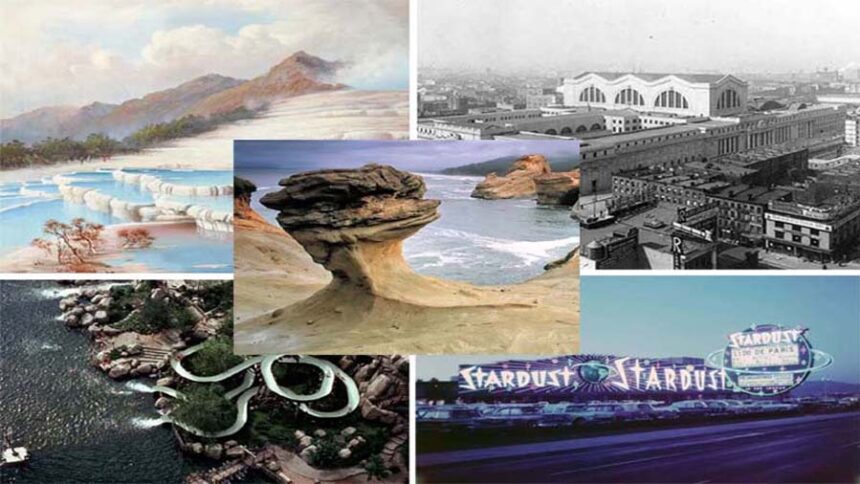
The Pink and White Terraces of New Zealand once stood as the eighth wonder of the world. These spectacular geothermal structures cascaded beautifully into Lake Rotomahana on the North Island. During the nineteenth century, they represented one of the most famous lost travel destinations for wealthy international voyagers. Hot, silica-rich water crystallized over centuries, forming massive pools of pink and white stone tiers. Visitors traveled for months by ship to bathe in these natural thermal basins.
However, disaster struck violently in June 1886. The nearby Mount Tarawera erupted unexpectedly, triggering a massive volcanic cataclysm that permanently destroyed the entire landscape. The lake bed fractured, swallowing the terraces into a deep volcanic crater. Consequently, this natural wonder vanished from the physical map overnight. Recent underwater expeditions confirm that the remnants lie buried deep beneath layers of volcanic mud. Therefore, this location remains a legendary symbol of lost travel destinations destroyed by nature’s raw power.
The Sunken Pirate Capital of Port Royal
Port Royal, Jamaica, once held a reputation as the wickedest city on Earth. During the seventeenth century, it operated as a bustling maritime hub for privateers, merchants, and notorious pirates. Its strategic geographical position made it an incredibly wealthy settlement. Travelers from across the Atlantic visited its crowded ports to trade gold, spices, and luxury goods. Port Royal was a vibrant city full of brick structures, fortresses, and busy commercial centers.
This prosperity ended abruptly on June 7, 1692. A massive earthquake struck the island, causing the sandy foundations of the city to liquefy instantly. Within minutes, a massive tsunami swallowed two-thirds of the settlement deep into the Caribbean Sea. Therefore, Port Royal transformed from a bustling capital into one of the most unique submerged lost travel destinations in history. Today, the sunken city functions as a preserved time capsule for underwater archaeologists studying maritime history.
The Guaíra Falls: Erased by Modern Industrial Power
Nature is not always the sole culprit behind the disappearance of global wonders. The Guaíra Falls, situated on the border between Brazil and Paraguay, represented the most powerful waterfall on Earth by volume. The thunderous roar of the Paraná River plunging through narrow rocky gorges could be heard from kilometers away. For decades, it stood as a prime eco-tourism hotspot, attracting thousands of adventurers who wanted to witness its immense hydrodynamic energy.
However, in 1982, human engineering permanently altered the landscape. The construction of the massive Itaipu Dam necessitated the complete flooding of the falls to create a massive industrial reservoir. Engineers used dynamite to clear the rock formations, submerging the natural wonder beneath a calm, artificial lake. Consequently, the Guaíra Falls became one of the most tragic human-made lost travel destinations of the modern era, sacrificed for industrial advancement.
The Ancient Library of Alexandria and Submerged Heritage
The Library of Alexandria represented the intellectual capital of the ancient world. Founded in Egypt during the third century BC, it housed hundreds of thousands of papyrus scrolls containing the collective knowledge of humanity. Philosophers, mathematicians, and astronomers traveled across the Mediterranean to study within its walls. However, successive fires, military conflicts, and coastal earthquakes gradually destroyed the monumental structure over centuries.
Furthermore, massive seismic activity caused the ancient royal quarters of Alexandria to slide directly into the Mediterranean Sea. Recent underwater excavations have uncovered giant sphinxes, columns, and statuary lying silent on the ocean floor. These submerged ruins form an eerie grid of lost travel destinations that historians are still actively cataloging. Therefore, the legacy of Alexandria highlights how both cultural knowledge and physical architecture can vanish over time.
Preserving the Memory of Vanished Geographies
Studying these vanished landscapes is not just an academic exercise in historical geography. Instead, it serves as a critical requirement for understanding modern environmental vulnerability. By exploring how these lost travel destinations disappeared, climate researchers and engineers improve their ability to protect coastal infrastructure. Every submerged ruin or buried terrace provides a vital piece of data regarding how the Earth manages systemic shifts.
Decoding these patterns allows humanity to navigate an environment that is becoming increasingly volatile. We must learn to coexist with the transformative forces of our planet. While we can never fully rebuild these machines of natural beauty, our ability to document their history has fundamentally changed. As we look to the future, digital preservation and advanced mapping will remain our primary tools to keep these lost travel destinations alive in human memory.