


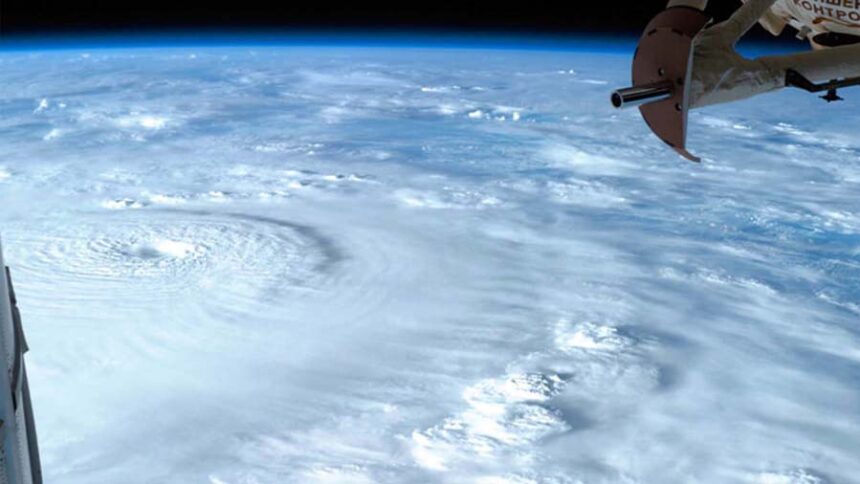
Nature rarely operates through straight lines. It prefers curves, spirals, and vortexes. When a hurricane forms, it represents an unstable system where massive oceanic energy collides with the Earth’s rotational momentum. This creates a lethal thermodynamic trap that defies even the most advanced supercomputers. These storms can span hundreds of kilometers while unleashing wind speeds exceeding 300 kilometers per hour. Beneath the swirling cloud cover lies a process governed by the search for order amidst intense disorder.
Fluid dynamics experts characterize this as a “vortex cascade.” Instead of a uniform movement, the storm fragments into increasingly smaller components. Kinetic energy transfers across scales, moving from the macroscopic environment down to the microscopic level. This constant flux explains the inherent difficulty in forecasting a cyclone’s exact trajectory. The vortex is never static; it is a fluid dance that changes shape, intensity, and dimensions in mere fractions of a second.
Thermodynamic Engines of the Deep Ocean
A hurricane requires specific conditions to ignite, primarily fueled by the vast tropical sea basins. Surface water temperatures must typically reach between 27 and 28 degrees Celsius to activate the atmospheric engine. Massive evaporation transfers gargantuan amounts of energy from the sea to the sky. As this saturated vapor rises into the cooler upper atmosphere, it condenses into towering storm clouds. This condensation process releases latent heat, which acts as the primary fuel for the entire system.
This release of heat creates a powerful positive feedback loop. Rapidly rising air necessitates a constant inflow of surrounding air to replace it. As this air rushes toward the low-pressure center, the Coriolis force—a consequence of Earth’s rotation—deflects the flow. In the Northern Hemisphere, this forces an counter-clockwise rotation, whereas the Southern Hemisphere experiences the opposite. Once established, the storm organizes into a perfect circular structure with a calm eye, becoming an autonomous, self-sustaining entity that only dissipates when it hits land or colder waters.
The Diverse Galaxy of Rotational Phenomena
While hurricanes dominate oceanic narratives, the Earth hosts a broader spectrum of rotating phenomena. Tornadoes represent a distinct, highly localized category of intense energy. Their formation depends on “wind shear,” where wind speed and direction change significantly with altitude. When strong updrafts encounter this horizontal rotation, the column of air turns vertical, creating a dangerous funnel. These storms may last only minutes, yet they possess a localized energy density that frequently exceeds that of a full-scale hurricane.
Other manifestations include waterspouts and the famous “dust devils” seen in arid deserts. Observations on Mars confirm that these columns of rising dust are a universal occurrence whenever surface temperatures spike. Extreme conditions, such as massive forest fires, can even trigger fire whirls—terrifying columns of rotating flame. It is a common misconception that household sinks rotate due to the Coriolis effect. In reality, such small-scale rotations are merely the result of basin geometry, initial water flow, and residual movement.
From Jovian Storms to Galactic Spirals
Earth acts as a minor theater in the grand universal drama of vortexes. Jupiter hosts the Great Red Spot, a gargantuan cyclone that has raged for over three centuries. Because Jupiter lacks a solid surface, there is no friction to interrupt the storm’s momentum. Its density and internal heat dynamics sustain this tempest, allowing it to span dimensions that would swallow our entire planet. These storms serve as living laboratories for physicists studying long-term atmospheric evolution.
On a cosmic scale, the vortex remains the universe’s preferred architecture. Colliding galaxies are drawn into a slow, multi-million-year spiral of gas and dust. Near black holes, matter forms an accretion disk—a final, violent vortex of pure energy before matter crosses the event horizon. These macro-structures follow the same fundamental physical laws as the micro-currents in our atmosphere. The universe organizes itself through rotation, turning chaos into structured energy across all spatial dimensions.
Survival Through Predictive Science
Studying these phenomena is not just an academic exercise for astrophysicists; it is a requirement for modern survival. By refining climate models and understanding fluid turbulence, we improve our ability to protect vulnerable communities. The scientific community is currently attempting to turn the study of chaos into a strategic defense system. Every vortex we document provides a piece of the puzzle regarding how our planet manages its internal energy. Decoding this language allows humanity to navigate an environment that is becoming increasingly volatile due to environmental shifts. We are learning to coexist with the raw power of the planet by acknowledging that unpredictability is part of the system. While we may never fully tame these machines of destruction, our ability to forecast their movements has fundamentally changed. As we look to the future, the mastery of atmospheric dynamics will remain our primary shield against the unpredictable forces of the natural world.