


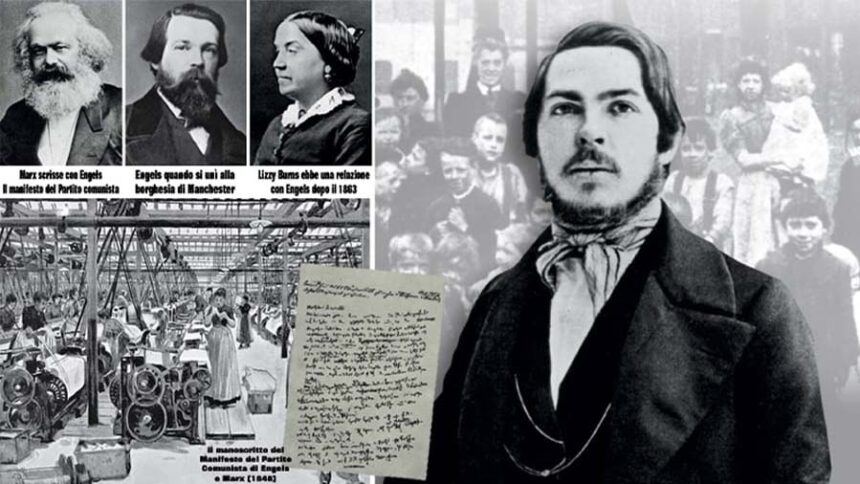
Yet, within this cocoon of extreme conformity, a profound intellectual rebellion began to take shape. During his adolescent years, Engels grew increasingly disenchanted with the hierarchical structure of his society. His discontent was not a fleeting phase but a radical shift in consciousness. He began to challenge not just his family’s religious dogmas, but the entire ethical framework that sustained economic oppression. He discovered that his pen was his most effective weapon for the coming ideological struggle.
Observing the Human Cost of Industry
The young intellectual began writing articles that exposed the unbearable living conditions of factory laborers. He possessed a rare ability to peer beneath the veneer of industrial advancement. While others celebrated technological progress, Engels focused on the human misery fueling that growth. This capacity to maintain a critical distance, despite his own privileged background, allowed him to see the inherent injustices of the period. He became an intruder within his own social class.
When he moved to Manchester, then the world’s textile capital, his transformation reached a critical turning point. England offered him a laboratory to witness the raw, unfiltered reality of capitalism. The city was defined by thick smoke billowing from countless chimneys, covering working-class districts where human lives seemed to hold less value than the coal fueling the looms. Engels refused to observe this tragedy merely from his office window. He ventured into the narrow, damp alleys.
The Sociological Foundation of Socialism
He engaged directly with those living in extreme poverty, transforming his observations into a groundbreaking sociological investigation. His work provided more than just a moral outcry against suffering. He dissected the economic mechanics of the era, studying wage fluctuations with clinical precision. He demonstrated how the entire production system was meticulously designed to extract maximum value from laborers. This empiricism became the structural backbone of scientific socialism, providing Marx and the labor movement with the necessary evidence.
His thesis was categorical: exploitation was not a mere malfunction of the system. Instead, he argued that it was an essential, built-in feature of private property ownership. This firsthand experience provided the vital data required to articulate the theory of systemic oppression. By documenting the mechanics of capital, he proved that a total transformation of the socio-economic order was not just an idealistic desire, but a historical necessity. His findings validated the urgent call for revolutionary change.
The Symbiotic Partnership with Karl Marx
The collaboration between Engels and Karl Marx was more than a simple intellectual friendship. It was a strategic symbiosis that altered the course of global history. When they met, the synergy was immediate and profound. Marx brought formidable philosophical power and a systemic approach to building complex models. Conversely, Engels offered practical knowledge of economic dynamics and a pragmatic sensitivity. He understood the nuances of the market in a way that his partner often lacked.
In this powerful union of minds, Engels consciously chose to remain in the shadows. He allowed Marx to dominate the public sphere, acting as the primary face of their revolutionary theory. This decision was rooted in deep mutual respect and a clear understanding of his own supporting role. Engels did far more than simply draft or revise manuscripts. He became the financial lifeblood of the entire Marxist project, providing the monetary support that allowed his friend to write Das Kapital.
The Paradox of Funding the Revolution
The core of the “Engels Paradox” lies in his dual existence. He worked for years within the system he wished to destroy, managing business affairs and accumulating wealth. He lived a double life, playing the part of an impeccable bourgeois entrepreneur by day. Then, in the intimacy of his private study, he transitioned into the devoted apostle of revolution. He did not view this as hypocrisy, but as a tragic necessity for his cause.
He was willing to soil his hands with the fruits of the capitalist economy to ensure the theoretical vision could be completed. His life poses a provocative question: can one truly fight a system without utilizing its resources? His biography suggests that revolutions often rely on the very gears they intend to dismantle. Eventually, he abandoned commerce to dedicate his full energy to political militancy. He became the diligent guardian of radical thought, providing strategic advice to emerging movements across Europe.
A Legacy for the Modern Era
Today, the contradictions that defined his life—the wealthy businessman preaching the end of private property—only serve to highlight his political and human complexity. He was not a secular saint of the revolution, but a man deeply immersed in his era. He possessed a sharp awareness of the tensions inherent in a rapidly expanding global system. Re-reading his works today feels remarkably relevant, as we face new manifestations of the same economic inequalities. The challenges he observed—technological impact on labor and the widening gap between classes—remain central issues in our contemporary world. He taught us that meaningful change does not happen in a theoretical vacuum. It requires an analytical understanding of the existing power structures. His history serves as a constant reminder that behind every massive political idea are individuals forced to negotiate between their reality and their dreams. He remains an essential guide for those looking to understand the mechanics of power.