

In the hidden shallows of tropical seas, a monumental biological empire is fading away. Scientists warn that the vibrant underwater cities known as coral reefs—ancient structures older than modern continents—are approaching an irreversible tipping point. Rising ocean temperatures, plastic pollution and accelerating acidification are dismantling ecosystems that once flourished undisturbed for hundreds of millions of years. As global institutions raise the alarm and researchers race to understand the limits of coral resilience, the fate of these fragile organisms becomes inseparable from the future of marine biodiversity and coastal economies. The crisis unfolding beneath the surface is not only ecological; it is geopolitical, economic and generational. And the clock is ticking.
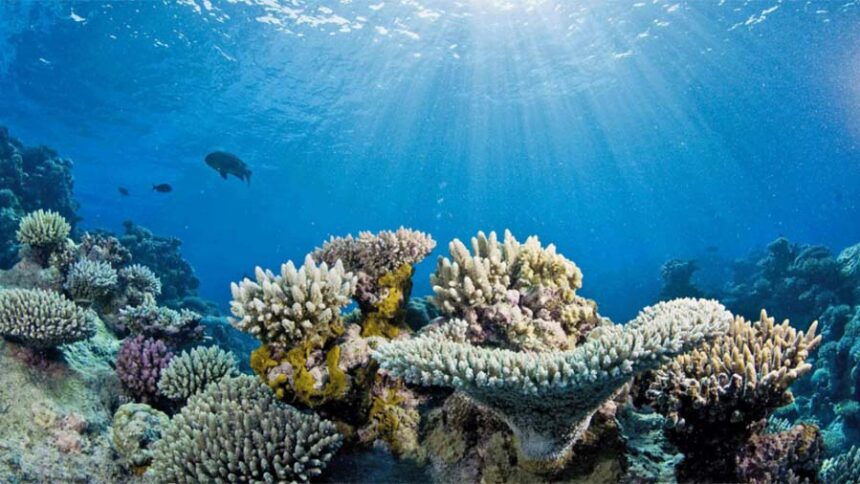
Marine biologists, international agencies and universities across the globe are sounding the alarm: coral reefs, located primarily in tropical waters between the Tropic of Cancer and the Tropic of Capricorn, are undergoing unprecedented degradation today due to rising temperatures, pollution and human pressure. Their decline threatens thousands of marine species, coastal communities and global biodiversity, prompting urgent calls for coordinated scientific action.
A Kingdom Older Than Continents
The world’s coral formations are not merely scenic landscapes; they are living monuments whose origins stretch back more than half a billion years. Long before the continents assumed their current shapes, primitive coral organisms were already constructing vast underwater fortresses. These early builders belonged to ancient groups of marine invertebrates that thrived in warm, shallow waters. Their skeletal structures, made of calcium carbonate, accumulated over millennia, forming the first reefs during the Ordovician period. At that time, Earth was a tropical planet, its climate uniformly warm, its oceans teeming with bizarre creatures such as giant sea scorpions—predators larger than humans that patrolled the primordial seabed.
Modern reefs are the descendants of those ancient architectures, shaped by the delicate balance between coral growth and natural erosion. Every coral polyp contributes a tiny “stone” to the structure, and when it dies, its skeleton remains, becoming part of the reef’s expanding body. This slow, continuous construction has produced some of the most complex ecosystems on Earth.
The Misunderstood Identity of Coral
Despite their fame, not all organisms commonly called “corals” are true corals in the scientific sense. Marine biologists emphasize that the authentic coral—Corallium rubrum, the red coral prized for centuries—is only one species within a specific family of octocorals. The organisms that build tropical reefs, often referred to as corals in everyday language, are actually madreporas, belonging to a different order entirely. These reef‑forming creatures are responsible for the massive underwater structures that host thousands of species, yet their identity is frequently confused in popular culture.
This distinction matters because each group responds differently to environmental stress. Madreporas, the architects of reefs, are particularly sensitive to changes in temperature and salinity. Their survival depends on stable conditions that are rapidly disappearing.
The Bleaching Crisis: A Global Emergency
In recent years, coral reefs have suffered a wave of destruction without precedent. The phenomenon known as coral bleaching—a process triggered primarily by rising ocean temperatures—has spread across the globe. When stressed, corals expel the symbiotic algae that give them color and energy. What remains is a ghostly white skeleton, vulnerable and starving.
The Great Barrier Reef, a UNESCO World Heritage site and one of the most biodiverse regions on the planet, has experienced repeated bleaching events that have devastated large portions of its ecosystem. Marine experts explain that corals require at least a decade to recover from a single bleaching episode, provided no new heatwaves occur. But the intervals between events are shrinking, leaving little time for regeneration.
The consequences extend far beyond biology. Countries whose economies depend on tourism, fishing and coastal protection face severe losses. Coral reefs act as natural barriers against storms and erosion; their disappearance exposes coastlines to greater risks.
Science on the Front Lines: New Strategies for Survival
As the crisis intensifies, researchers are developing innovative methods to preserve what remains. One approach, known as Coral Restoration, involves cultivating coral fragments in underwater nurseries and transplanting them onto damaged reefs. These interventions aim to accelerate natural recovery, though their success depends on stable environmental conditions.
At Oregon State University, scientists are conducting controlled experiments to identify coral species capable of withstanding extreme heat. In specialized tanks that mimic natural conditions, researchers adjust salinity, temperature and light to observe how corals adapt. By monitoring genetic changes across multiple species, they hope to understand which traits enable survival in a warming ocean.
These accelerated studies, which compress years of natural evolution into months, are crucial. As one researcher explained indirectly, the pace of reef decline is so rapid that traditional long‑term observation is no longer sufficient. The urgency of the situation demands faster scientific responses.
Three Global Strongholds of Coral Biodiversity
Despite the crisis, three major regions still host the majority of the world’s coral reefs. The Indian Ocean region, stretching from the Red Sea to Indonesia, contains roughly 45 percent of global reef formations. The Indo‑Pacific region, extending from Southeast Asia to Polynesia, accounts for another 40 percent. The remaining 15 percent lies in the Caribbean, where numerous islands shelter diverse coral communities.
Among these, the Red Sea stands out as a unique sanctuary. Although similar in size to France, it hosts more than 1,200 fish species, over 330 coral species and hundreds of mollusks and crustaceans. Its high salinity has fostered an extraordinary number of endemic species found nowhere else on Earth. This exceptional biodiversity makes the Red Sea one of the most valuable marine ecosystems in the world—and one of the most vulnerable.
A Natural Heritage at the Brink
The collapse of coral reefs is not a distant threat; it is unfolding now, with consequences that will shape the future of oceans and humanity. International organizations urge nations to share scientific knowledge and adopt coordinated policies. The slogan “Our Ocean, Our Future” reflects a growing awareness that protecting reefs is inseparable from protecting life itself.
Half of the world’s population is under 25, and global institutions hope that younger generations will become the driving force behind ocean conservation. Their choices—political, economic and cultural—will determine whether coral reefs survive or vanish within decades. The fate of these ancient underwater cities is a test of humanity’s ability to respond to environmental crisis. Saving them requires not only science, but collective will.